Field note / The mechanism
NAD+ research: the salvage pathway, the consuming enzymes, and the human precursor trials
How cells make and spend NAD+, and what the controlled human studies of NMN and nicotinamide riboside have measured.
Start here
This page walks through NAD+ research from the inside of the cell outward. NAD+ (the molecule that carries electrons through energy metabolism) is made and recycled by a loop called the salvage pathway, and it is steadily used up by three families of enzymes — sirtuins, PARPs, and CD38. When you swallow an "NAD+" product you are almost always taking a precursor (a building block, usually NMN or NR) that feeds that loop. The human trials below measured one thing reliably — blood NAD+ goes up — and several other things less certainly. We keep that distinction explicit throughout.
How cells make and spend NAD+
NAD+ does two jobs at once. As a redox carrier, it cycles between its oxidized form (NAD+) and reduced form (NADH), accepting electrons in glycolysis and the TCA cycle and donating them in the mitochondrial electron transport chain to drive ATP synthesis [5]. As a signaling substrate, it is consumed — physically used up — by sirtuins (a family of cellular-maintenance enzymes that cannot work without NAD+), by PARP1 (a DNA-repair enzyme), and by CD38 (an NAD-consuming enzyme on cell surfaces) [5].
That second role is why levels matter. Because sirtuins, PARPs, and CD38 all draw from one shared NAD+ pool, anything that raises CD38 activity lowers what is left for the rest. Camacho-Pereira and colleagues showed that CD38 is the principal NAD+-consuming enzyme whose activity rises with age, and that deleting CD38 in mice preserves NAD+ levels and SIRT3 activity and improves mitochondrial function [2]. The age-related fall in tissue NAD+ is, in large part, a story of rising consumption.
NAD+ precursors and the salvage pathway
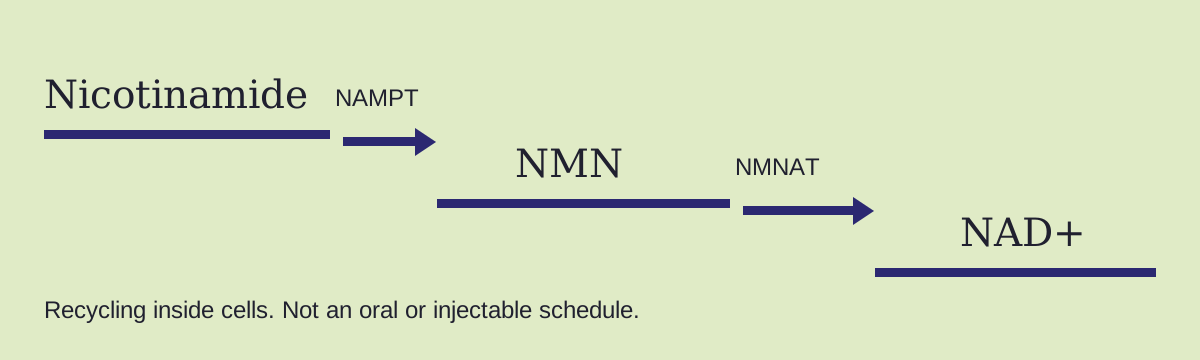
A NAD+ precursor is a smaller molecule the body converts into NAD+. The dominant route in mammals is the salvage pathway, which recycles nicotinamide back into NAD+ through the rate-limiting enzyme NAMPT (nicotinamide phosphoribosyltransferase), then NMNAT [11]. NAMPT activity sets the pace of the whole loop; its expression is induced by exercise and follows a daily circadian rhythm [11].
Nicotinamide riboside takes a slightly different on-ramp: it is phosphorylated by the NRK1/NRK2 kinases into NMN, then converted to NAD+, bypassing part of the standard route [12]. Structural work has mapped these steps atom by atom — the NRK1 kinase structure that defines how NR is phosphorylated [12], and the human NMNAT structure that catalyzes the universal NMN-to-NAD+ step [13]. These enzymes are old: a comparative analysis across 45 species found the Preiss-Handler pathway and NAD+ kinase present in every organism examined and apparently ancestral [14].
Nicotinamide mononucleotide (NMN): the most-replicated oral precursor
NMN (nicotinamide mononucleotide) sits one biochemical step from NAD+, which is why it is the most-studied oral precursor. The strongest human result is a multicenter, double-blind, placebo-controlled, dose-dependent trial: oral NMN at 300, 600, or 900 mg/day for 60 days raised blood NAD+ significantly at days 30 and 60 across all groups versus placebo (p ≤ 0.001), improved walking distance, and identified 600 mg/day as the optimal dose, with no safety issues at any dose [3].
A separate mechanistic trial gave prediabetic, postmenopausal women 250 mg/day of NMN for ten weeks and found a significant increase in muscle insulin sensitivity by hyperinsulinemic-euglycemic clamp — but no change in body composition or HbA1c [1]. The pattern is consistent: NMN reliably raises NAD+ and moves some functional measures, while leaving others unchanged. It is a precursor that feeds the NAD+ pool, not NAD+ itself.
Nicotinamide riboside (NR): the most clinically studied oral booster
Nicotinamide riboside (NR) has the largest controlled human dataset of any NAD+ precursor. In a randomized, double-blind, placebo-controlled trial in healthy overweight adults, NR at 100, 300, or 1000 mg/day for eight weeks raised whole-blood NAD+ by 22%, 51%, and 142% respectively [4]. The elevation was dose-dependent and maintained throughout the study, with no flushing and no significant adverse-event difference from placebo at any dose; NR also did not elevate LDL cholesterol or disrupt one-carbon metabolism [4].
This is the clearest dose-response curve in the precursor literature — a clean demonstration that an oral compound can scale whole-blood NAD+ across nearly an order of magnitude. What it does not show is a clinical endpoint; the trial measured NAD+ and safety, not disease outcomes.
NAD+ vs NMN: why oral products are usually precursors
The NAD+ vs NMN question comes up because product labels blur them. The distinction is real and worth keeping straight. NAD+ is the finished coenzyme — a large, charged dinucleotide (663.43 Da) that most cells do not take up intact, which is why plain oral "NAD+" capsules are widely considered an inefficient way to raise cellular NAD+. NMN is a precursor one step upstream: smaller, transported into cells, and converted to NAD+ by NMNAT [13].
So when a study reports that "oral NMN raised blood NAD+," it is not a study of taking NAD+ — it is a study of taking a precursor. Describing an oral-NMN or oral-NR trial as "taking NAD+" misstates the chemistry. Throughout this digest, the route and the molecule are named exactly as the cited study used them.
Is taking NAD orally effective?
Plain oral NAD+ is poorly absorbed intact, which is why most oral products are precursors — NMN and NR — that the cell converts into NAD+. Those precursors reliably and dose-dependently raise blood NAD+ in controlled trials: NR by 22/51/142% at 100/300/1000 mg/day [4], and NMN across 300-900 mg/day [3]. "Effective" at raising the biomarker is well established; "effective" at producing a clinical outcome in humans remains preliminary [15].